























As concerns about teen screen addiction grow, a Generation Z–led movement called Appstinence is gaining attention for encouraging young people to disconnect from social media entirely — a shift that some students at Sacred Hearts Academy are beginning to explore.
According to national studies on youth media use, teenagers spend several hours per day on social media platforms, prompting growing concern among educators and researchers about potential impacts on mental health, sleep and attention.

Started in 2024, Appstinence is a social cause calling for abstention from social media and artificial intimacy. Sentiment and support for the movement have been growing, as the Generation Z–led group and the Appstinence community took part in Delete Day in October 2025. The event was a mass deletion and anti–social media gathering in New York City where people were encouraged to delete one addictive app of their choice from their phones.
Jaryn Wong, a junior at the Academy, has been aware of Appstinence and follows a similar lifestyle. While she still has an iPhone, she is committed to staying off social media.
“I think it’s a positive idea because it encourages people to be more mindful about how much time they spend online and how it affects their self-esteem and productivity,” Wong said.
She added that choosing to stay off social media can sometimes make her feel different from her peers.
“I kind of feel left out sometimes,” she said. “But to overcome it, I just think that it helps me focus more on my studies, and I don’t need social media to have a better life.”
As research continues to examine links between social media use and issues such as anxiety, depression and body image, some advocates argue that moderation is not enough, leading to movements like Appstinence that promote abstaining altogether.
Defining Appstinence
In 2024, Harvard alumna Gabriela Nguyen founded Appstinence to help people reimagine life without constant digital connection. Nguyen believes social media’s effects are difficult to recognize because many young people have never lived without it.
“(Quitting social media isn’t) obvious to us. It’s a lot of either unknown or a lot of never lived without it,” Nguyen stated in a Harvard news article. “And…that’s why in addiction research abstention plays such a big role because when you remove the stimulus…you…learn (a lot) about how much control it had over you.”
Concerns surrounding social media use among teens have increased in recent years. According to the New York Post, 96% of children by the age of 10-15 have used social media, and seven out of 10 have been exposed to harmful content. Additionally, a Polish study on “The Impact of Social Media on Body Image Perception in Young People” showed that exposure to athletic images decreased self-esteem in 37% of participants, particularly among women.
Abstention from social media has been shown to have beneficial effects on young adults and their mental health. According to The Harvard Gazette, a JAMA Network Open study on “Social Media Detox and Youth Mental Health” showed that those who participated in a 1-week social media detox reduced symptoms of anxiety by 16.1%, depression by 24.8% and insomnia by 14.5%, proving that reducing social media use can improve mental health outcomes in young adults.
To guide participants through the process of reducing screen use, Nguyen developed the “5D Method.”
Decrease: Users delete all apps from their phones and access them only through browsers on other devices such as laptops or tablets. This introduces a barrier to the mindless habit of opening apps. After decreasing usage for a few weeks, participants move on to deactivation.
Deactivate: Social media platforms provide a 30-day deactivation period before an account is permanently deleted. Participants begin by deactivating the accounts of apps they use the least. This gradually reduces sources of stimulus while making the transition less abrupt.
Delete: After 30 days, accounts are permanently deleted. Ideally, participants will not notice the days passing, but if they do, direct communication such as calling friends is encouraged to maintain connections.
Downgrade: Participants repeat the second and third steps until the final app is deactivated and deleted. They may then transition to a non-smartphone device, such as a flip phone.
Depart: Depending on where participants are in the process, they are encouraged to reflect on how spending time offline has changed their daily lives and habits.
“It’s not a utopian fantasy of like, ‘Oh, if only I could run out into the woods and leave all my technology behind and get off social media and reinvent myself,’” Nguyen said. “It’s something that people are actually doing.”
Wong said the movement’s principles align with how she already chooses to manage her own social media use.
“I relate to (Appstinence’s principles) because I think it’s important to have control over technology instead of letting it control you,” she said.
Appstinence in a post-pandemic world
Since the COVID-19 pandemic, screen use has become more embedded in daily life, making it harder for teens to disconnect. Studies show that time spent on digital devices rose sharply during lockdowns as schools shifted to remote learning and social interactions moved online.
One study found that adolescents’ recreational screen time nearly doubled during the early months of the pandemic, increasing from about 3.8 hours per day to 7.7 hours. Researchers say the shift normalized frequent use of smartphones, social media and streaming platforms in everyday routines.
In response to these concerns, some governments have introduced stricter regulations on youth access to social media. In December 2025, Australia became the first country to implement a nationwide ban on social media use for children under 16, citing concerns over mental health and online safety. Early reports show that social media platforms removed about 4.7 million accounts belonging to under-16 users within the first month of the law taking effect, though researchers say it is still too early to determine the policy’s long-term effects.
However, some reports indicate that teenagers have attempted to bypass the restrictions by creating new accounts or accessing platforms through alternative devices and accounts. Researchers and policymakers are continuing to monitor how the policy may affect young people’s digital habits and well-being.
Finding Appstinence at the Academy

As Appstinence gains attention, similar conversations are taking place at the Academy.
According to Upper School Counselor Ululani Reyes, the counseling department addresses social media use annually through guidance lessons.
“I think it helps students grow closer to one another and build social skills,” Reyes said. “It’s beneficial not just for kids, but for adults too, because adults need to model what healthy relationships with devices look like.”
Reyes emphasized that support systems are key for students attempting to reduce screen time.
“Teachers and parents can model healthier habits by being fully present, making eye contact, greeting others and engaging in face-to-face conversations,” she said. “For younger children, allowing boredom instead of relying on devices can encourage creativity.”
She added that time away from screens can promote physical activity, innovation and social development.
Behind the scenes of Appstinence
Appstinence representatives say the movement is not about judgment but awareness.
“I did the two weeks and never redownloaded the app,” said Henry Michaelson, the head of programming for Appstinence, who spoke on behalf of the organization. “From there, I started feeling the fatigue of social media and began researching the topic more academically.”
Michaelson said Nguyen faced challenges while balancing the organization’s growth with her responsibilities as a student, but her commitment helped expand Appstinence into a global movement.
“She never compromised the mission statement,” Michaelson said. “That consistency helped build momentum.”
Appstinence maintains an active “Buzz” page translated into languages such as Italian and Spanish, sharing low-stimulus content aligned with the movement’s principles. Last month, Nguyen delivered a TEDx talk discussing her appstinent journey.
Students use social media to grow small businesses
While some students choose to reduce or eliminate social media use, others rely on the platforms for different purposes, including entrepreneurship.
Academy junior Karys Shimizu uses Instagram to promote her handmade press-on nail business, nailsxkarys, in which she currently has over 50 followers.
Most of Shimizu’s customers are friends, family members and fellow students who learn about her business through word of mouth or social media. She uses the platform primarily to post her work and communicate with customers through direct

messaging.
“Social media helps me stay in touch with my customers,” Shimizu said. “It also allows me to showcase my work and creativity.”
Shimizu said Instagram plays an important role in keeping her business visible, especially during busy times like prom season, when demand for custom nails increases.
Without social media, she said, it would be harder to reach customers and grow her business.
“If I had to stop relying on social media, my business wouldn’t be as well known, and I would see a decrease in customers,” Shimizu said.
Her experience, she said, reflects the broader debate surrounding social media use. While some advocates encourage limiting or eliminating platforms altogether, others say they remain valuable tools for communication, creativity and small businesses.
Related coverage
Listen: “Ka Leo Konvos” podcast discussing the Appstinence movement and perspectives on social media use, featuring Sacred Hearts Academy students and a school counselor.
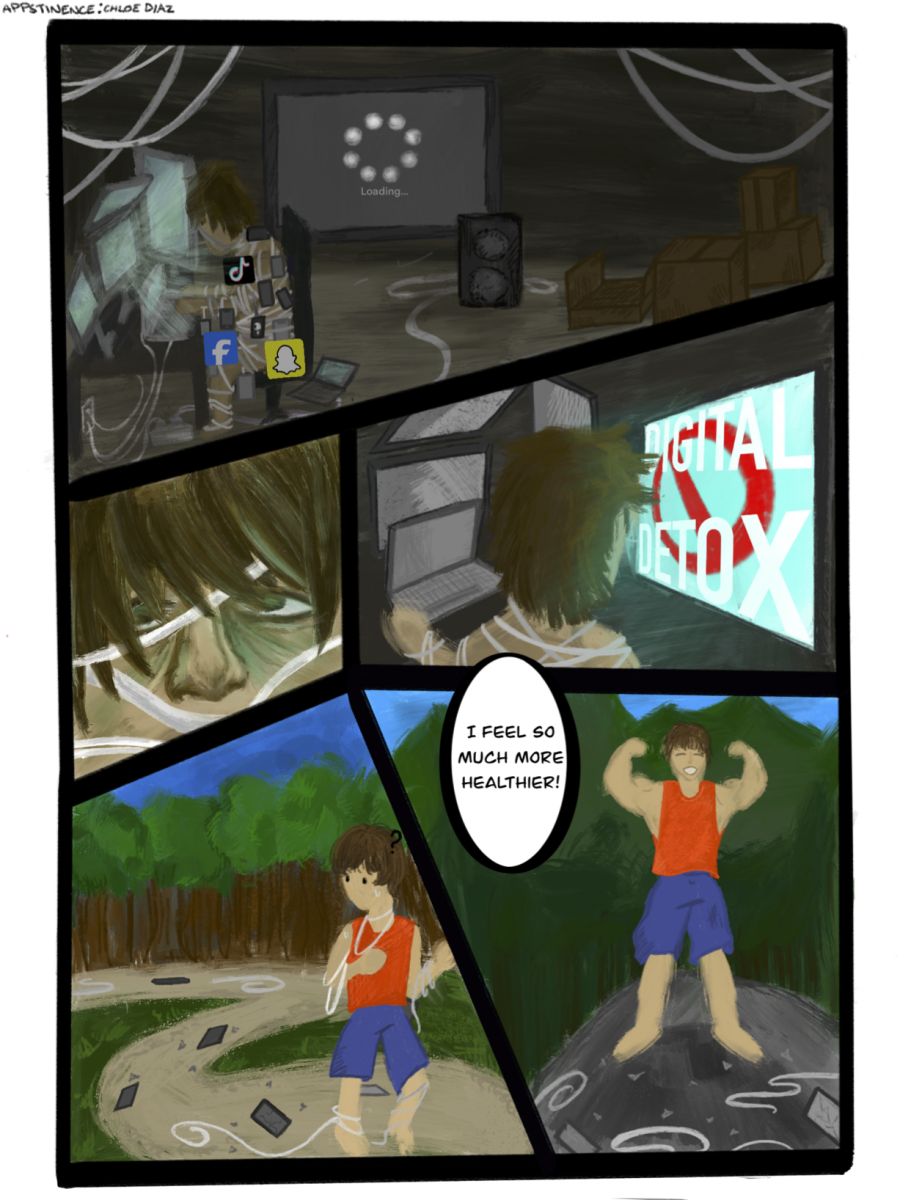
View: Editorial comic illustrating a teen disconnecting from social media and embracing a digital detox.

As the comic progresses, the character steps away from devices and spends time outdoors, symbolizing a gradual break from the apps and cables that once surrounded them. The final scene shows the teen standing confidently in nature, suggesting renewed energy and well-being after disconnecting from constant online activity.
The illustration reflects ideas discussed in the “Ka Leo” article “Appstinence: The movement to digital detox.” The article explains that Appstinence is a Generation Z–led movement encouraging young people to rethink their relationship with smartphones and social media and reduce dependence on digital platforms.
By illustrating a teen breaking free from devices and reconnecting with the real world, the comic visually represents the growing conversation among young people about digital balance and the benefits of stepping away from constant online engagement. (Chloe Diaz)